
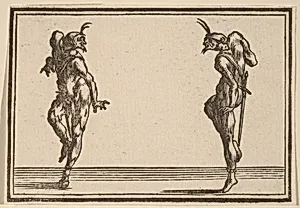
Two Pantaloons Dancing
Medium
woodcut on laid paper
Dimensions
sheet (trimmed to block): 5.7 × 8.2 cm (2 1/4 × 3 1/4 in.)
Classification
Department
CG-E
Museum
National Gallery of Art, Washington, D.C.
Credit
R.L. Baumfeld Collection
Accession Number
1969.15.230
Rights
Public Domain
Art Historical Context
"Two Pantaloons Dancing is a delightful small-scale woodcut on laid paper, created in1621 by Edouardman after the renowned French printmaker Jacques Call. Measuring just 5.7 × 8.2 cm, this trimmed print captures two figures of Pantalone—the miserly, scheming old Venetian merchant from commedia dell'arte mid-dance. Callot, a master of intricate line work and dynamic compositions, was celebrated for his vivid depictions of theatrical life, and Eckman's faithful reproduction preserves that spirit in this compact format. Printed on laid paper, a common support for early modern prints that reveals subtle chain lines under light, the woodcut technique allowed for bold, expressive lines ideal for capturing movement and caricature. Commedia dell'arte, the improvised street theater popular across Europe in the 17th century, featured masked stock characters like Pantalone, whose exaggerated antics entertained audiences from Italy to France. This print likely draws from Callot's influential series exploring such performers, blending satire with artistry. Housed in the National Gallery of Art's R.L. Baumfeld Collection (Department CG-E), it exemplifies the era's printmaking boom, making high art accessible. Visitors can imagine these pantaloons twirling at a festive ballo, a snapshot of Baroque-era revelry frozen in enduring ink.
About the Artist
Edouard Eckman after Jacques Callot
Edouard Eckman, a Flemish printmaker born around 1600, remains a somewhat enigmatic figure in art history, with his early life not well documented. Little is known about his training or formal education, though his oeuvre suggests familiarity with the vibrant printmaking traditions of the early Baroque period in Northern Europe. Active primarily in the second decade of the seventeenth century, Eck...