
Umazukushi
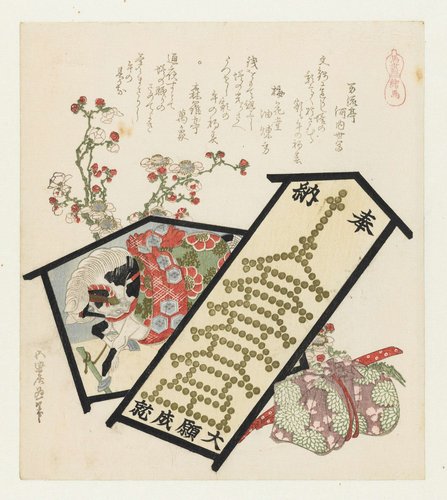
Medium
nishikie, with metallic pigments and mica overprinting
Dimensions
183; 207
Rights
Public Domain
About this artwork
Een surimono is een luxe uitgevoerde prent waarop beeld met één of meerdere gedichten gecombineerd is. Bij het drukken van een surimono werd vaak gebruik gemaakt van dikker papier, blinddruk en metaal pigmenten, zoals koper- en zilverpoeder. De prenten werden vaak in opdracht van dichters gemaakt en als exclusief geschenk aan vrienden en relaties gegeven.
Art Historical Context
**Umazukushi by Katsushika Hokus (1822)** Step into the refined world of Edo-period Japan with *Umazukushi*, a exquisite surimono created by the legendary ukiyo-e master Katsika Hokusai in 1822. Measuring just 207mm by 183mm, this intimate woodblock print—known as *nishikie* or "brocade picture"—showcases Hokusai's mastery of vibrant colors, metallic pigments, and mica overprinting, lending it a shimmering, jewel-like quality. Surimono were luxury editions, far from mass-produced prints, blending evocative imagery with poetry for an elite audience. These prints were typically produced on thicker paper using advanced techniques like embossing (blind printing) and powdered metals such as copper and silver, as seen here. Commissioned by poets, they served as exclusive New Year's gifts or tokens of friendship among literati circles, embodying Japan's cultural fusion of visual art and haiku verse. Hokusai's dynamic composition reflects ukiyo-e's "floating world" ethos, capturing fleeting beauty with precision. *Umazukushi* highlights surimono's historical role in fostering artistic patronage, preserving ephemeral poems in opulent form. A testament to Hokusai's innovative printmaking, it invites us to appreciate the tactile splendor of traditional Japanese craftsmanship. (198 words)
About the Artist
Katsushika Hokusai · 1760–1849
Katsushika Hokusai (1760-1849) stands as one of history's most influential artists, a Japanese master who revolutionized the ukiyo-e woodblock print tradition and profoundly shaped Western art. Born in the Katsushika district of Edo (modern-day Tokyo) to an artisan family, Hokusai lived through nearly nine decades of extraordinary creative evolution, adopting over thirty different artistic names t...