
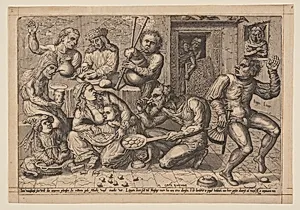
Vuyl Sause (Dirty Sauce)
c. 1559
Medium
Etching on ivory laid paper
Dimensions
Plate: 19.4 × 28.6 cm (7 11/16 × 11 5/16 in.); sheet: 21.3 × 30.9 cm (8 7/16 × 12 3/16 in.)
Classification
Department
Prints and Drawings
Museum
Art Institute of Chicago
Accession Number
264856
Rights
Public Domain
Art Historical Context
**Vuyl Sause (Dirty Sauce)** *Hieronymus Cock, c. 1559* Etching on ivory laid paper; Plate: 19.4 × 28.6 cm Step into the vibrant world of 16th-century Antwerp with Hieronymus Cock's *Vuyl Sause (Dirty Sauce)*, a witty etching whose Dutch title hints at playful wordplay or satire, evoking the earthy humor of Netherlandish proverbs. Cock (c. 1518–1570), a pioneering Flemish printmaker and publisher, was a master of disseminating intricate designs across Europe through his workshop, Aux Quatre Vents. Active during the Northern Renaissance's print boom, he often reproduced fantastical landscapes and moral scenes inspired by artists like Hieronymus Bosch, capturing the era's blend of realism and imagination amid religious upheavals and artistic innovation. This etching exemplifies Cock's technical prowess in intaglio printing, where acid etches fine lines into a metal plate for rich, tonal depth—rarer than engraving at the time and ideal for subtle textures on ivory laid paper. Its modest size made it accessible for collectors, fueling the democratization of art in an age before photography. Housed in the Art Institute of Chicago's Prints and Drawings collection, *Vuyl Sause* reflects printmaking's cultural power: affordable, reproducible images that spread ideas, folly, and beauty far beyond elite patrons, inviting us to ponder the "dirty sauce" of human quirks in Renaissance life.
About the Artist
Hieronymus Cock · 1510–1570
Hieronymus Cock, born Hieronymus Wellens de Cock in Antwerp in 1518, emerged from a distinguished artistic lineage; his father, Jan Wellens de Cock, and brother, Matthys Cock, were both accomplished painters and draftsmen. Admitted as a master painter to Antwerp's Guild of Saint Luke in 1545, he honed his skills in the vibrant Netherlandish tradition before traveling to Rome from 1546 to 1547, whe...