
Water Pipe Top
Unknown Artist
19th century
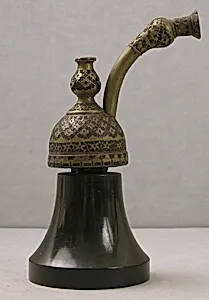
Medium
Zinc alloy; cast, engraved, inlaid with brass (bidri ware)
Dimensions
H. 6 5/8 in. (16.8 cm) W. 4 3/16 in. (10.6 cm) Diam. 3 in. (7.6 cm) Wt. 7.8 oz. (221.151 g)
Classification
Metal
Department
Islamic Art
Museum
Metropolitan Museum of Art, New York, NY
Credit
Edward C. Moore Collection, Bequest of Edward C. Moore, 1891
Accession Number
91.1.575
Rights
Public Domain
Art Historical Context
This exquisite *Water Pipe Top* from 19th century exemplifies masterful bidri ware technique, a of Islamic metalwork from the Deccan region of India.ed from zinc alloy, it was cast, finely engraved, and inlaid brass to create intricate designs that contrast beautifully against the dark, blackened metal surface. Bidri ware, named after the city of Bidar, emerged under the patronage of Muslim rulers and blended Persian influences with local Indian craftsmanship, producing durable, ornamental objects prized for their geometric patterns and floral motifs. Measuring just 6⅝ inches high and weighing under 8 ounces, this compact top likely crowned a hookah (water pipe), a cultural staple for social gatherings in South Asia and the Islamic world. Tobacco smoking via water pipes spread through Ottoman and Mughal empires in the 16th century, evolving into symbols of hospitality and refinement. The unknown artisan's skill in inlaying brass—achieved by etching designs, hammering in wire, and polishing—highlights the technical virtuosity that made bidri ware a luxury export. Part of the Metropolitan Museum of Art's Edward C. Moore Collection (bequeathed 1891), this piece invites us to appreciate the fusion of utility and artistry in everyday Islamic artifacts, where form elevates function into enduring beauty.