
Eagle Dance, Choctaw
1835-1837
Medium
Painting
Classification
Painting
Department
Smithsonian Collection
Museum
Smithsonian American Art Museum
Credit
Smithsonian American Art Museum, Gift of Mrs. Joseph Harrison, Jr.
Accession Number
1985.66.449
Rights
Public Domain
Tags
About this artwork
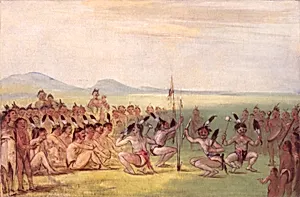
“The Eagle Dance, a very pretty scene . . . [was] got up by their young men, in honour of that bird, for which they seem to have a religious regard. This picturesque dance was given by twelve or sixteen men, whose bodies were chiefly naked and painted white, with white clay, and each one holding in his hand the tail of the eagle, while his head was also decorated with an eagle's quill. Spears were stuck in the ground, around which the dance was performed by four men at a time, who had simultaneo...
Art Historical Context
**Eagle Dance, Choaw** (1835–1837) by George Catlin captures a vibrant ceremonial dance performed by young Choctaw men near Fort Gibson in present-day Oklahoma, where the artist sketched the scene in 1834. Catlin, a pioneering 19th-century painter renowned for his extensive documentation of Native American cultures, portrayed twelve to sixteen dancers with bodies painted white using clay—a symbol of reverence for the eagle, a bird held in religious esteem by the Choctaw. Each dancer clutched an eagle's tail in one hand and wore a quill in his headdress, circling spears planted in the ground amid rhythmic drumbeats. The painting depicts the dance's unique, demanding movements: performers rose in rows of four from a seated position, squatting low with bodies nearly touching the earth in explosive jumps before yielding to the next group. This oil painting, now in the Smithsonian American Art Museum, exemplifies Catlin's style of ethnographic realism, blending keen observation with dramatic composition to preserve vanishing traditions amid the era's rapid westward expansion and tribal displacements like the Choctaw's Trail of Tears. Catlin's firsthand account in *Letters and Notes* (1841) brings the "picturesque" ritual to life, highlighting its cultural significance as a homage to nature's power. A testament to the Choctaw's rich heritage, this work invites visitors to appreciate the artistry and spirituality of Indigenous performances on the cusp of profound change.
About the Artist
George Catlin · 1796–1872
George Catlin (1796–1872), born in Wilkes-Barre, Pennsylvania, to Putnam Catlin and Polly Sutton—who had been captured by Native Americans during the 1778 Battle of Wyoming—initially pursued a legal career. Trained at Litchfield Law School, he was admitted to the bar in 1819 but abandoned law after two years to study art in Philadelphia in 1823. Self-taught as a portraitist, Catlin quickly gained ...