
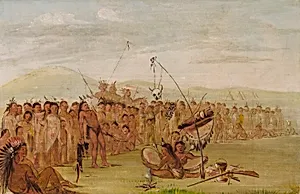
Self-torture in a Sioux Religious Ceremony
1835-1837
Medium
Painting
Classification
Painting
Department
Smithsonian Collection
Museum
Smithsonian American Art Museum
Credit
Smithsonian American Art Museum, Gift of Mrs. Joseph Harrison, Jr.
Accession Number
1985.66.460
Rights
Public Domain
Tags
About this artwork
George Catlin painted several images of Indian rituals involving self-torture, scenes that shocked viewers when he exhibited his Indian Gallery in London. Critics accused the artist of making up such horrendous scenes as this one of a man hanging from a pole with splints and skewers running through his flesh. Catlin insisted that he indeed witnessed this event, and reported that the man had “blood trickling down over his body, which was covered with white and yellow clay . . . amidst a great cro...
Art Historical Context
George Catlin, a pioneering 19th-century American artist captured the raw intensity of Native American life in 1830s through his extensive travels among Plains tribes. Created between 1835 and 1837, *Self-torture in Sioux Religious Ceremony* is oil painting from his renowned Indian Gallery, now housed in the Smithsonian American Museum. Catlin's realistic style, rooted in ethnographic documentation, aimed to preserve vanishing indigenous traditions before Western expansion altered them forever. The painting depicts a harrowing Sioux ritual where a man hangs from a pole, pierced by splints and skewers through his flesh. As Catlin described from firsthand observation, blood trickles down his body, painted with white and yellow clay, while he gazes steadfastly at the sun from dawn until dusk amid a sympathetic crowd. Survival earned him generous gifts, underscoring the ceremony's spiritual endurance test. When exhibited in London, the image stunned viewers, with critics accusing Catlin of fabrication. He staunchly defended its authenticity, highlighting profound cultural devotion. This work remains a vital window into Sioux religious practices, blending artistic vividness with historical testimony.
About the Artist
George Catlin · 1796–1872
George Catlin (1796–1872), born in Wilkes-Barre, Pennsylvania, to Putnam Catlin and Polly Sutton—who had been captured by Native Americans during the 1778 Battle of Wyoming—initially pursued a legal career. Trained at Litchfield Law School, he was admitted to the bar in 1819 but abandoned law after two years to study art in Philadelphia in 1823. Self-taught as a portraitist, Catlin quickly gained ...