
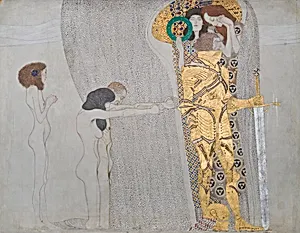
Beethovenfries: Die Leiden der schwachen Menschheit und Der wohlgerüstete Starke - Tafel 3, linke Langwand
1901/1902
Medium
Kaseinfarben, Stuckauflagen, Zeichenstift, Applikationen aus verschiedenen Materialien (Glas, Perlmutt etc.), Goldauflagen auf Mörtel
Dimensions
215 x 276 cm
Classification
Wandbild
Department
Belvedere Collection
Museum
Belvedere
Credit
Belvedere, Vienna
Accession Number
5987/3
Rights
Public Domain
About this artwork
Die Leiden der schwachen Menschheit richten ihre Bitten an den wohlgerüsteten Starken, der als Ritter in goldener Rüstung dargestellt ist. Hinter ihm befinden sich die Personifikationen von Mitleid und Ehrgeiz.
Art Historical Context
Gustav Klimt created this striking mural panel in 1901–1902 as part of his celebrated Beethoven Frieze, a monumental work originally designed for the Vienna Secession’s fourteenth exhibition. The frieze served as a visual tribute to Ludwig van Beethoven’s Ninth Symphony, transforming its themes of struggle and redemption into a richly symbolic narrative. Klimt, a leading figure of the Vienna Secession movement, blended Symbolist ideas with his distinctive decorative style to explore humanity’s quest for fulfillment. In this section, the sufferings of weak humanity reach out in desperate plea toward a golden-armored knight, the “well-fortified strong one.” Behind the knight stand the personifications of Compassion and Ambition, underscoring the moral and emotional forces that guide heroic action. The scene captures Klimt’s fascination with allegory and the tension between vulnerability and strength. Executed in casein paint, stucco relief, pencil, and lavish applications of gold leaf, glass, and mother-of-pearl on plaster, the 215 × 276 cm panel exemplifies Klimt’s innovative approach to mural painting. Now housed in the Belvedere Collection in Vienna, it remains a powerful example of how early-twentieth-century artists merged fine art with craft traditions to create immersive, emotionally resonant environments.
About the Artist
Gustav Klimt · 1862–1918
Gustav Klimt was born on July 14, 1862, in Baumgarten near Vienna, the second of seven children in a modest family of artistic bent. His father, Ernst Klimt, a gold engraver who had immigrated from Bohemia, and his mother, Anna Finster, an aspiring musician, instilled an early appreciation for craft and creativity amid financial hardship. Klimt displayed prodigious drawing talent, prompting his en...