
Freundinnen (Wasserschlangen I)
1904 (geringfügige Ergänzungen 1907)
Medium
Aquarell, Gouache, Bleistift, Gold, Silber, Platin und Messing auf Pergament
Dimensions
50 × 20 cm
Classification
Gemälde
Department
Belvedere Collection
Museum
Belvedere
Credit
Belvedere, Vienna
Accession Number
5077
Rights
Public Domain
About this artwork
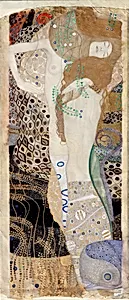
Märchenhaft von der Wirklichkeit entrückt erscheinen die von Klimt als „Wasserschlangen” oder „Nixen” bezeichneten Wesen. In verträumt fließender Bewegung schweben sie inmitten von goldenem Seetang über dem Meeresgrund. Aus dem rechten unteren Bildbereich blickt uns mit starrem Auge ein schillernder Fisch entgegen. Inspiriert von der Kunstströmung des Symbolismus setzt der Künstler diese Unterwasserwesen als Versinnbildlichung einer mystischen Welt ein. Klimt realisiert die Arbeit auf Pergament ...
Art Historical Context
In the enchanting *Freundinnen (Werschlangen I)*, created by Gustav Klimt in 1904 with minor additions in 190, ethereal female figures—dubbed "Wasserschlangen" or water nymphs by the artist—drift dreamily amid swirling golden seaweed on a fantastical seabed. A single, iridescent fish gazes rigidly from the lower right, adding a touch of otherworldly tension. This intimate 50 × 20 cm work, housed in Vienna's Belvedere Collection, captures a fairy-tale detachment from reality, evoking a mystical underwater realm. Klimt executed this piece at the height of his Golden Phase, a pinnacle of his career marked by lavish use of gold, silver, platinum, and brass applied over watercolor, gouache, pencil, and the uncommon support of parchment. This opulent technique, inspired by Symbolism, transforms the nymphs into embodiments of sensuality and enigma, blending Art Nouveau fluidity with Byzantine splendor. The shimmering metals create a luminous, jewel-like quality, heightening the dreamlike flow. As a rare preparatory study on parchment, it reflects Klimt's innovative experimentation during Vienna's Secessionist movement, bridging symbolism and modernism. Visitors are drawn into its hypnotic allure, a testament to Klimt's mastery in portraying feminine mystery through gilded fantasy.
About the Artist
Gustav Klimt · 1862–1918
Gustav Klimt was born on July 14, 1862, in Baumgarten near Vienna, the second of seven children in a modest family of artistic bent. His father, Ernst Klimt, a gold engraver who had immigrated from Bohemia, and his mother, Anna Finster, an aspiring musician, instilled an early appreciation for craft and creativity amid financial hardship. Klimt displayed prodigious drawing talent, prompting his en...