
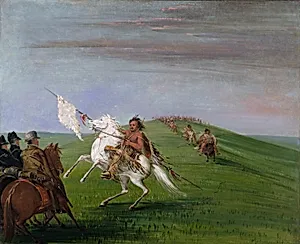
Comanche Meeting the Dragoons
1834-1835
Medium
Painting
Classification
Painting
Department
Smithsonian Collection
Museum
Smithsonian American Art Museum
Credit
Smithsonian American Art Museum, Gift of Mrs. Joseph Harrison, Jr.
Accession Number
1985.66.488
Rights
Public Domain
Tags
About this artwork
“Col. Dodge ordered the command to halt, while he rode forward with a few of his staff, and an ensign carrying a white flag. I joined this advance, and the Indians stood their ground until we had come within half a mile of them, and could distinctly observe all their numbers and movements. We then came to a halt, and the white flag was sent a little in advance, and waved as a signal for them to approach; at which one of their party galloped out in advance of the war-party, on a milk white horse,...
Art Historical Context
**Comanche Meeting the Dragoons**1834-1835) is a vivid painting by George Catlin the pioneering American artist renowned for his ethnographic documentation of Native American life Catlin, who traveled extensively in the 1830s to capture Indigenous peoples before the tide of westward expansion altered their worlds forever, sketched this dramatic encounter firsthand. The scene depicts a tense yet ceremonial first meeting between Comanche warriors and U.S. Dragoons under Colonel Henry Dodge in Indian Territory (present-day Oklahoma), symbolizing the collision of cultures during America's push westward. In Catlin's own words from his *Letters and Notes* (1841), a lone Comanche rider on a milk-white horse approaches under a white flag and buffalo skin, galloping, prancing, and leaping in a display of bravery that captivated both sides. Leaning his lance against the American ensign, he extends a hand to Dodge, marking a moment of fragile diplomacy amid the vast plains. This oil painting, now in the Smithsonian American Art Museum, preserves the raw energy of the event through Catlin's realistic style, blending portrait-like detail with dynamic action. As a key artifact of 19th-century expansion, the work highlights Comanche horsemanship and pride while underscoring the U.S. military's role in treaty negotiations and conflicts. Catlin's unflinching records offer invaluable insight into a vanishing era, inviting us to reflect on the human stories behind history's grand narratives.
About the Artist
George Catlin · 1796–1872
George Catlin (1796–1872), born in Wilkes-Barre, Pennsylvania, to Putnam Catlin and Polly Sutton—who had been captured by Native Americans during the 1778 Battle of Wyoming—initially pursued a legal career. Trained at Litchfield Law School, he was admitted to the bar in 1819 but abandoned law after two years to study art in Philadelphia in 1823. Self-taught as a portraitist, Catlin quickly gained ...