
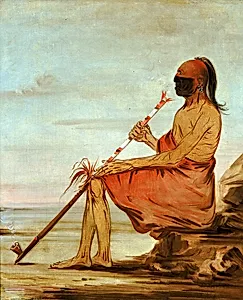
Coo-coo-coo, The Owl, an Aged Chief
1836
Medium
Painting
Classification
Painting
Department
Smithsonian Collection
Museum
Smithsonian American Art Museum
Credit
Smithsonian American Art Museum, Gift of Mrs. Joseph Harrison, Jr.
Accession Number
1985.66.232
Rights
Public Domain
Tags
About this artwork
George Catlin described Menominee chief Coo-coo-coo as a “very aged and emaciated chief, whom I painted at Green Bay, in Fort Howard. He had been a distinguished man, but now in his dotage, being more than 100 years old---and a great pet of the surgeon and officers of the post.” This portrait was painted in 1836 when Catlin stopped at Green Bay on his way to the Pipestone Quarry. (Truettner, The Natural Man Observed, 1979)
Art Historical Context
In 1836, renowned artist George Catlin captured the dignified visage of Coo-coo-coo, known as "The Owl," an elderly Menominee chief, in this poignant oil portrait now housed at the Smithsonian American Art Museum. Catlin, a pioneering chronicler of Native American life, painted the chief during a stop at Fort Howard in Green Bay, Wisconsin, route to the sacred Pipestone Quarry. At over 100 years old Coo-coo-coo embodied resilience amid the rapid changes of frontier America. Catlin himself described the chief as " aged and emaciated a once-distinguished leader now in his dotage and affectionately regarded as a "great pet" by the post's surgeon and officers. This intimate portrayal reflects Catlin's Romantic style, emphasizing the nobility and humanity of his subjects against the backdrop of encroaching Euro-American expansion. As part of Catlin's ambitious project to document over 140 tribes before their cultures faded, the painting offers a vital historical snapshot of Menominee heritage. Today, this work underscores the cultural importance of preserving Indigenous stories, inviting visitors to reflect on the passage of time and the chief's enduring spirit.
About the Artist
George Catlin · 1796–1872
George Catlin (1796–1872), born in Wilkes-Barre, Pennsylvania, to Putnam Catlin and Polly Sutton—who had been captured by Native Americans during the 1778 Battle of Wyoming—initially pursued a legal career. Trained at Litchfield Law School, he was admitted to the bar in 1819 but abandoned law after two years to study art in Philadelphia in 1823. Self-taught as a portraitist, Catlin quickly gained ...