
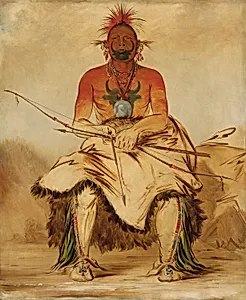
La-dóo-ke-a, Buffalo Bull, a Grand Pawnee Warrior
1832
Medium
Painting
Classification
Painting
Department
Smithsonian Collection
Museum
Smithsonian American Art Museum
Credit
Smithsonian American Art Museum, Gift of Mrs. Joseph Harrison, Jr.
Accession Number
1985.66.100
Rights
Public Domain
Tags
About this artwork
Described by George Catlin “as a warrior of great distinction,” Buffalo Bull appears “with his medicine or totem (the head of a buffalo) painted on his breast and his face, with bow and arrow in his hands.” This unfinished portrait provides a key to Catlin’s working methods in the West, where he had to work quickly. During Buffalo Bull’s sitting, Catlin focused on his face and his totem (the buffalo head painted on his chest, partially hidden behind a large peace medal). The artist usually finis...
Art Historical Context
George Catlin's *La-dóo-ke-a, Buffalo Bull, Grand Pawnee Warrior* (1832) captures a moment of profound cultural encounter during the artist's ambitious expedition into the American West. Catlin, a pioneering 19th-century painter dedicated to documenting Native American life before it vanished under waves of settlement, portrayed Buffalo Bull—a distinguished Pawnee warrior—as a symbol of resilience and tradition. Painted amid the urgency of frontier travel, this full-length portrait shows the warrior adorned in Indian dress and jewelry, gripping a bow and arrow, with his sacred buffalo totem boldly painted on his chest and face. The artwork's unfinished quality offers a rare glimpse into Catlin's innovative techniques. Working swiftly during sittings in remote settings, he prioritized the face and totem—partially obscured by a large peace medal—leaving the body and costume details for later completion in his urban studio. This method preserved authentic expressions and symbols of Pawnee identity, such as the "medicine" buffalo emblem signifying spiritual power and status. Housed in the Smithsonian American Art Museum, this piece from Catlin's famed Indian Gallery underscores the artist's role in early ethnographic art, bridging worlds and immortalizing Indigenous dignity for future generations.
About the Artist
George Catlin · 1796–1872
George Catlin (1796–1872), born in Wilkes-Barre, Pennsylvania, to Putnam Catlin and Polly Sutton—who had been captured by Native Americans during the 1778 Battle of Wyoming—initially pursued a legal career. Trained at Litchfield Law School, he was admitted to the bar in 1819 but abandoned law after two years to study art in Philadelphia in 1823. Self-taught as a portraitist, Catlin quickly gained ...