
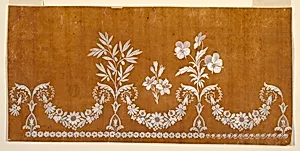
Design for an Embroidered or Woven Horizontal Border of the "Fabrique de St. Ruf"
1805–1815
Classification
Drawing
Department
Smithsonian Collection
Museum
Smithsonian American Art Museum
Credit
Gift of Eleanor and Sarah Hewitt
Accession Number
1914-21-121
Rights
Public Domain
About this artwork
Research in Progress
Art Historical Context
This delicate drawing, titled *Design for an Embro or Woven Horizontal Border the "Fabrique de. Ruf"*, hails from the renowned textile workshops of Lyon, France, created between 1805 and 1815. Produced by the Fabrique de Saint Ruf—a prominent manufactory in the city's silk district—this piece served as a pattern for luxurious embroidered or woven borders. Lyon, long Europe's silk capital, thrived during the Napoleonic, when demand for opulent fabrics surged for fashion, furnishings, and imperial grandeur. As a classified drawing with an unknown medium, it exemplifies the precision of textile design drafts from the era. These works were essential blueprints, translating artistic vision into complex looms or embroidery frames, often blending neoclassical motifs with innovative patterns suited to mechanical weaving advances. The horizontal border format suggests use in shawls, draperies, or garments, highlighting the fusion of artistry and industry. Gifted to the Smithsonian American Art Museum by collectors Eleanor and Sarah Hewitt, this artifact underscores the transatlantic appreciation for French design. Though research continues, it offers a window into Lyon's golden age of textiles, where craftsmanship met commerce in creating enduring elegance.