
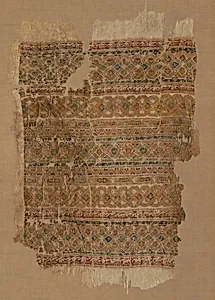
Fragment
Fatimid period (969–1171), late 11th/early 12th century
Medium
Silk, tapestry weave
Dimensions
50.8 × 35.6 cm (20 × 14 in.)
Classification
textile
Department
Textiles
Museum
Art Institute of Chicago
Accession Number
50403
Rights
Public Domain
About this artwork
In early and medieval times (from the late 7th century to about 1200), throughout the Islamic world, state-owned factories produced textiles both for use at court and for commercial sale. Known as tiraz (after the word for embroidery, suggesting the original technique), these textiles were intended as furnishing fabrics or robes, to be conferred as royal gifts. early examples were decorated with narrow bands of ornament and inscriptions that often included the name of the patron and the location...
About the Artist
Islamic
Islamic art, a profound visual tradition originating in the 7th century CE, flourished across vast territories from Spain to India under Muslim rule, encompassing architecture, ceramics, manuscripts, textiles, and metalwork produced by diverse artisans rather than a single named master. Drawing from pre-Islamic Sasanian, Byzantine, and late antique influences, its early development under the Umayy...