
Gates, City, London
after 1887
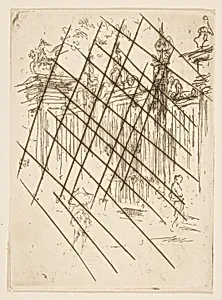
Medium
Etching, printed in black ink on heavy off-white wove; impression from the cancelled plate (Glasgow)
Dimensions
Plate: 5 3/16 × 3 3/4 in. (13.2 × 9.6 cm) Sheet: 5 3/16 × 3 3/4 in. (13.2 × 9.6 cm)
Classification
Prints
Department
Drawings and Prints
Museum
Metropolitan Museum of Art, New York, NY
Credit
Harris Brisbane Dick Fund, 1917
Accession Number
17.3.140
Rights
Public Domain
Tags
Art Historical Context
James McNeill Whistler, renowned American-born artist who made London his home, captured the gritty elegance of the city's financial district in *Gates City, London*, an etching created after 1887. This intimate print depicts ornate iron gates in the heart of the City of London, evoking the bustling Victorian urban landscape Whistler so admired. Known for his atmospheric depictions of Thames-side scenes and nocturnal cityscapes, Whistler was a leader in the 19th-century etching revival, blending Realism with Aestheticism to prioritize mood and harmony over narrative detail. Printed in black ink on heavy off-white wove paper, this rare impression comes from the "cancelled plate" edition produced in Glasgow, where Whistler oversaw printing to control quality. Cancelled plates were deliberately defaced after a limited run to ensure rarity, making such prints collector's treasures. The modest plate size—5 3/16 × 3 3/4 inches—highlights etching's power for precision: Whistler's needle etched fluid lines and subtle textures, achieving velvety blacks and glowing whites that mimic London's foggy haze. Acquired by The Metropolitan Museum of Art through the Harris Brisbane Dick Fund in 1917, this work exemplifies Whistler's innovative printmaking, bridging fine art and graphic media. It invites visitors to ponder the timeless interplay of shadow and structure in everyday architecture, a hallmark of his poetic urban vision.
About the Artist
James McNeill Whistler · 1834–1903
James Abbott McNeill Whistler (1834-1903) was an American-born painter and printmaker who became a leading figure in the Aesthetic Movement and pioneer of Tonalism and Japonisme. He revolutionized art by championing "art for art's sake" and treating paintings as visual equivalents of musical compositions, titling works as "arrangements," "harmonies," and "nocturnes" to emphasize formal qualities o...