
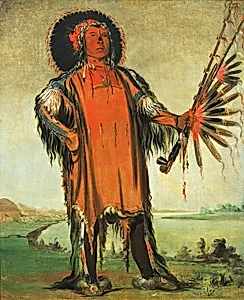
Ha-na-tá-nu-maúk, Wolf Chief, Head Chief of the Tribe
1832
Medium
Painting
Classification
Painting
Department
Smithsonian Collection
Museum
Smithsonian American Art Museum
Credit
Smithsonian American Art Museum, Gift of Mrs. Joseph Harrison, Jr.
Accession Number
1985.66.127
Rights
Public Domain
Tags
About this artwork
“This man is head-chief of the [Mandan] nation, and familiarly known by the name of ‘Chef de Loup’ as the French Traders call him; a haughty, austere, and overbearing man, respected and feared by his people rather than loved. The tenure by which this man holds his office, is that by which head-chiefs of most of the tribes claim, that of inheritance . . . The dress of this chief was one of great extravagance, and some beauty; manufactured of skins, and a great number of quills of the raven, formi...
Art Historical Context
**Ha-na-tá-nu-maúk, Wolf Chief, Head Chief the Tribe** (1832) is a striking portrait by George Catlin, the pioneering American artist who dedicated his career to documenting Native American life the early 19th century. Painted during Catlin's expedition up the Missouri River to aan village, it captures Ha-na-tá-nu-maúk—known to French traders as "Chef Loup" or Wolf Chief—as the head chief of the Mandan nation. Cat's work belongs to his ambitious "Indian Gallery," a visual archive created amid rapid cultural changes, including devastating smallpox epidemics that decimated tribes like the Mandan. In Catlin's own words from his *Letters and Notes* (1841), the chief was "haughty, austere, and overbearing," respected and feared rather than loved by his people. His office passed by inheritance, a common practice among many tribes. The portrait highlights his extravagant attire: a stylish headdress of raven quills and skins, symbolizing status and spiritual power in Mandan culture, where wolves held symbolic importance in rituals and leadership. As an oil painting, this piece exemplifies Catlin's realistic style, blending ethnographic accuracy with romantic idealism to preserve vanishing traditions. Housed in the Smithsonian American Art Museum, it offers visitors a poignant window into pre-contact Plains Indian leadership and the urgency of Catlin's mission to record a world on the brink of transformation.
About the Artist
George Catlin · 1796–1872
George Catlin (1796–1872), born in Wilkes-Barre, Pennsylvania, to Putnam Catlin and Polly Sutton—who had been captured by Native Americans during the 1778 Battle of Wyoming—initially pursued a legal career. Trained at Litchfield Law School, he was admitted to the bar in 1819 but abandoned law after two years to study art in Philadelphia in 1823. Self-taught as a portraitist, Catlin quickly gained ...