
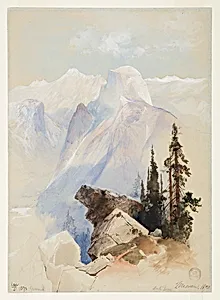
Half Dome, Yosemite
Classification
landscapes
Department
Smithsonian Collection
Museum
Smithsonian American Art Museum
Credit
Gift of Thomas Moran
Accession Number
1917-17-32
Rights
Public Domain
About this artwork
Vertical vista features the granite peak of Half Dome, Yosemite, looming between boulders in the foreground and snowcapped mountains in the distance. In foreground, jutting rocks at center, pine trees and spruce at right.
Art Historical Context
Thomas Moran's *Half Dome, Yosemite* (1873) captures the awe-inspiring grandeur of California's Yosemite Valley, a vertical vista dominated by the iconic granite peak of Half Dome. Rising dramatically between foreground boulders and distant snowcapped mountains, the composition draws the viewer into nature's sublime scale. Jutting rocks anchor the center, while pine trees and spruce at the right add textured depth, evoking the rugged wilderness Moran encountered during his Western expeditions. As a leading figure in 19th-century American landscape painting, Moran—born in Britain but a defining voice of the Hudson River School—excelled at romanticizing the American West. His luminous, atmospheric works, like this one, celebrated the continent's untouched beauty amid post-Civil War expansion. Painted just years after Yosemite was ceded to California as a protected grant in 1864, it reflects growing national appreciation for natural wonders, foreshadowing the valley's national park status in 1890. Gifted by Moran himself to the Smithsonian American Art Museum, this landscape underscores his legacy as an artist-advocate for preservation. Though the medium is unspecified, its vivid composition invites visitors to ponder humanity's place amid enduring geological marvels.