
Head of Pythagoras
18th century
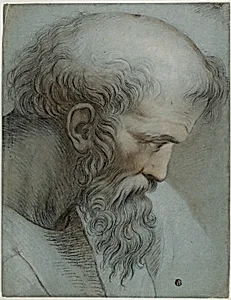
Medium
Black and red chalk with stumping, heightened with white chalk, on blue laid paper, laid down on cream laid paper
Dimensions
41.7 × 32.2 cm (16 7/16 × 12 11/16 in.)
Classification
chalk
Department
Prints and Drawings
Museum
Art Institute of Chicago
Accession Number
85357
Rights
Public Domain
Art Historical Context
Behold the *Head of Pythagoras*, captivating chalk drawing attributed to the Renaissance master Raphael, though dated to the 18th century. This portrait captures the ancient Greek philosopher and mathematician—famed for his theorem and mystical teachings—with a profound intensity. Raphael, a pillar of the High Renaissance, renowned for his graceful depictions of classical figures, blending idealized beauty with lifelike expression. Housed in the Art Institute of Chicago's and Drawings department, this (41.7 × 32.2 cm) invites visitors to ponder Pythagoras's enduring legacy in art and science. Crafted in black and red chalk with stumping—a technique smoothing tones for subtle gradations—heightened with white chalk on blue laid paper, the drawing exemplifies virtuoso draftsmanship. The layered colors create depth and luminosity, evoking Raphael's innovative use of mixed media to achieve sculptural realism. Laid down on cream laid paper for preservation, it highlights the fragility and allure of Old Master drawings, once prized by collectors for their spontaneity. This piece bridges antiquity and the Enlightenment, reflecting 18th-century fascination with classical heroes amid Raphael's timeless influence. A testament to drawing's power as both study and standalone art, it reminds us how one thoughtful gaze can echo through millennia.
About the Artist
Raphael · 1483–1520
Raffaello Sanzio da Urbino, known simply as Raphael, was born on March 28 or April 6, 1483, in the cultured Duchy of Urbino to the court painter and poet Giovanni Santi and his wife Màgia Ciarla. Orphaned young—his mother died when he was eight and his father when he was eleven—Raphael was raised in Urbino's refined court under the guardianship of his paternal uncle Bartolomeo. He received his ear...