
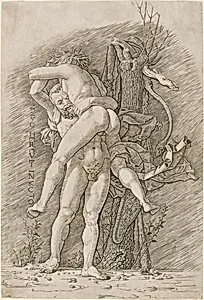
Hercules and Antaeus
c. 1495
Medium
engraving on laid paper
Dimensions
sheet: 32.8 x 22.4 cm (12 15/16 x 8 13/16 in.)
Classification
Department
CG-E
Museum
National Gallery of Art, Washington, D.C.
Credit
Gift of W.G. Russell Allen
Accession Number
1941.1.9
Rights
Public Domain
Art Historical Context
Behold the dynamic *Hercules and Antaeus an engraving from the workshop of Andrea Mantegna, created around 1495. This Renaissance masterpiece captures a pivotal moment from classical mythology: the mighty Hercules hoists the giant Antaeus off the ground, crushing him to thwart the earth-born warrior's invincibility. Mantegna, a pioneering Italian artist from Padua, was renowned for his mastery of, classical motifs, and intricate detail, influences that permeated his workshop's output during the late 15th century. Printed on laid paper—a period staple with its distinctive chain lines visible under light—this engraving exemplifies the revolutionary printmaking techniques of the Renaissance. By incising lines into a copper plate and inking it for transfer, artists like those in Mantegna's circle could produce multiple impressions, democratizing access to high art beyond elite patrons. Measuring 32.8 x 22.4 cm, its compact scale belies the monumental energy in the muscular forms and dramatic tension. Housed in the National Gallery of Art as a gift from W.G. Russell Allen (Department CG-E), this work highlights engraving's role in spreading humanist ideals and antique myths across Europe. Visitors, marvel at how Mantegna's precise lines evoke the raw power of heroism, bridging ancient lore with Renaissance innovation.