
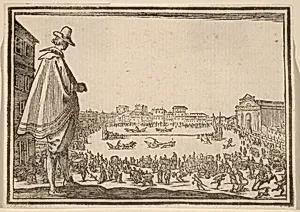
Piazza Santa Maria Novella, Florence
Medium
woodcut on laid paper
Dimensions
sheet: 5.7 × 8.3 cm (2 1/4 × 3 1/4 in.)
Classification
Department
CG-E
Museum
National Gallery of Art, Washington, D.C.
Credit
R.L. Baumfeld Collection
Accession Number
1969.15.242
Rights
Public Domain
Art Historical Context
Step into the vibrant heart of 17th-century Florence *Piazza Santa Maria Nov, Florence*, a delicate woodcut created in 1621 by Edouard Eckman after the renowned French printmaker Jacques Callot This tiny gem, measuring just 5.7 × 8.3 cm (2¼ × 3¼ in.), captures the bustling square before the iconic Santa Maria Novella church—a hub of Renaissance life, markets, and spectacles under Medici patronage. Callot, who lived and worked in Florence for the Grand Duke, was famed for his intricate depictions of urban scenes, blending sharp observation with dramatic flair. Printed on laid paper, a hallmark of early modern printmaking with its textured chains and wires visible under light, this woodcut reproduces Callot's masterful composition using relief carving techniques. Woodcuts allowed for bold lines and fine details in miniature formats, making such prints affordable and portable souvenirs for travelers and collectors. Eckman's faithful rendition preserves Callot's signature style from his *Vedute* series of Florentine views, showcasing his ability to pack teeming crowds and architecture into pocket-sized precision. Housed in the National Gallery of Art's R.L. Baumfeld Collection (Department CG-E), this print offers a window into Baroque-era Italy's cultural pulse. Imagine holding a slice of history in your palm—evidence of how prints democratized art, bridging elite patronage with everyday wonder.
About the Artist
Edouard Eckman after Jacques Callot
Edouard Eckman, a Flemish printmaker born around 1600, remains a somewhat enigmatic figure in art history, with his early life not well documented. Little is known about his training or formal education, though his oeuvre suggests familiarity with the vibrant printmaking traditions of the early Baroque period in Northern Europe. Active primarily in the second decade of the seventeenth century, Eck...