
Rainmaking among the Mandan
1837-1839
Medium
Painting
Classification
Painting
Department
Smithsonian Collection
Museum
Smithsonian American Art Museum
Credit
Smithsonian American Art Museum, Gift of Mrs. Joseph Harrison, Jr.
Accession Number
1985.66.476
Rights
Public Domain
Tags
About this artwork
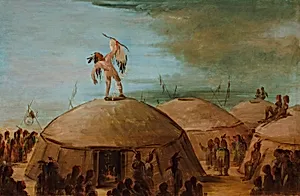
George Catlin was fascinated by the Mandan medicine men “performing their mysteries” and particularly noted the young men who “volunteer to stand upon the lodge from sunrise until sundown, in turn, commanding it to rain. Each one has to hazard the disgrace which attaches (when he descends at sundown) to a fruitless attempt; and he who succeeds acquires a lasting reputation as a Mystery or Medicine man.” (Catlin, 1848 Catalogue, Catlin’s Indian Gallery, SAAM online exhibition)
Art Historical Context
George Catlin's *Rainmaking among the Mand* (1837-1839) captures a sacred ritual of the Mandan people, a Native American tribe from the Upper Missouri River region. In the 1830s, Catlin traveled among Plains tribes, painting vivid scenes of their daily life and ceremonies to document cultures he feared were vanishing due to westward expansion and disease. This oil painting, now in the Smithsonian American Art Museum, reflects his role as both artist and ethnographer, blending Romantic realism with anthropological detail. The scene depicts a tense Rain Ceremony around a central hut, where young Mandan men volunteer to stand motionless from sunrise to sundown atop the lodge, invoking rain through chants and endurance. As Catlin noted in his 1848 catalogue, success elevated them to revered "Medicine men," while failure brought disgrace—a high-stakes test of spiritual power amid drought-prone prairies. The figure group conveys communal anticipation, highlighting the Mandan's profound connection to nature and ritual. Catlin's straightforward technique and earthy palette preserve these "mysteries" for posterity, offering modern viewers a window into pre-contact Indigenous traditions. This work underscores the cultural resilience of the Mandan, whose population later plummeted from smallpox epidemics Catlin himself witnessed.
About the Artist
George Catlin · 1796–1872
George Catlin (1796–1872), born in Wilkes-Barre, Pennsylvania, to Putnam Catlin and Polly Sutton—who had been captured by Native Americans during the 1778 Battle of Wyoming—initially pursued a legal career. Trained at Litchfield Law School, he was admitted to the bar in 1819 but abandoned law after two years to study art in Philadelphia in 1823. Self-taught as a portraitist, Catlin quickly gained ...