
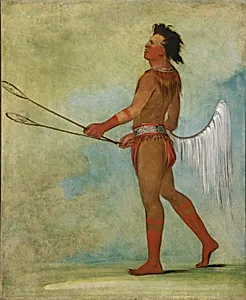
Tul-lock-chísh-ko, Drinks the Juice of the Stone, in Ball-player's Dress
1834
Medium
Painting
Classification
Painting
Department
Smithsonian Collection
Museum
Smithsonian American Art Museum
Credit
Smithsonian American Art Museum, Gift of Mrs. Joseph Harrison, Jr.
Accession Number
1985.66.299
Rights
Public Domain
Tags
About this artwork
“The most distinguished ball-player of the Choctaw nation, represented in his ball-play dress, with his ball-sticks in his hands. In every ball-play of these people, it is a rule of the play, that no man shall wear moccasins on his feet, or any other dress than his breech-cloth around his waist, with a beautiful bead belt, and a ‘tail,’ made of white horsehair or quills, and a ‘mane’ on the neck, of horsehair dyed of various colors.” George Catlin executed this work at Fort Gibson, Arkansas Terr...
Art Historical Context
George Catlin's *Tul-lock-chísh-ko, Drinks the Juice of the Stone, in Ball-player's Dress* (1834) captures a prominent Choctaw athlete poised in full regalia for the tribe's intense stickball game, a precursor to modern lacrosse. Painted on-site at Fort Gibson in Arkansas Territory, this full-length portrait exemplifies Catlin's pioneering mission to document Native American cultures through realistic, ethnographic paintings before rapid assimilation and displacement altered them forever. As part of his vast Indian Gallery collection, it reflects the Romantic era's fascination with indigenous life amid 19th-century American expansion. The subject's attire adheres strictly to Choctaw ball-play rules: barefoot to ensure fair play, clad only in a breech-cloth, ornate bead belt, a flowing "tail" of white horsehair or quills, and a vibrant "mane" of dyed horsehair around the neck. These elements, rendered with Catlin's precise oil technique, highlight the ritualistic beauty and athletic rigor of the sport, central to Choctaw social and spiritual traditions. Today, housed in the Smithsonian American Art Museum, this work endures as a vivid testament to Choctaw identity and Catlin's urgent artistry, bridging cultures for modern viewers.
About the Artist
George Catlin · 1796–1872
George Catlin (1796–1872), born in Wilkes-Barre, Pennsylvania, to Putnam Catlin and Polly Sutton—who had been captured by Native Americans during the 1778 Battle of Wyoming—initially pursued a legal career. Trained at Litchfield Law School, he was admitted to the bar in 1819 but abandoned law after two years to study art in Philadelphia in 1823. Self-taught as a portraitist, Catlin quickly gained ...