
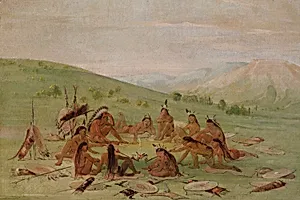
Foot War Party in Council, Mandan
1835-1837
Medium
Painting
Classification
Painting
Department
Smithsonian Collection
Museum
Smithsonian American Art Museum
Credit
Smithsonian American Art Museum, Gift of Mrs. Joseph Harrison, Jr.
Accession Number
1985.66.458
Rights
Public Domain
Tags
About this artwork
“This party was made up of the most distinguished and desperate young men of the tribe, who had sallied out against the [Arikara/Sahnish], and taken the most solemn oath amongst themselves never to return without achieving a victory. They had wandered long and faithfully about the country, following the trails of their enemy; when they were attacked by a numerous party, and lost several of their men and all their horses . . . In this plight, it seems, I had dropped my little canoe alongside of t...
Art Historical Context
George Catlin's *Foot War Party in Council Mandan* (1835–1837) captures a poignant moment from his travels among the Mandan people along the Missouri River in the 1830s. As a American artist and ethnographer, Catlin dedicated his career to documenting Native American life and customs before widespread European-American encroachment. This oil painting, now in the Smithsonian American Art Museum, stems from his firsthand encounter with a group of elite Mandan warriors during his expedition. The scene depicts a "foot war party"—distinguished young men who had sworn a solemn oath to return victorious against their Arikara enemies but suffered heavy losses, including men and horses. Seated on buffalo robes around a central fire, they light pipes amid stacked weapons, embodying stoic resilience. Catlin highlights the leader's contemplative pose, his striking war headdress of eagle quills and ermine trailing down his back, portraying him as a "natural hero" in defeat. This work exemplifies Catlin's realistic style, blending portraiture with narrative to preserve vanishing Indigenous traditions. It offers visitors a vivid window into Mandan warrior culture, emphasizing themes of bravery, council, and communal strength amid adversity.
About the Artist
George Catlin · 1796–1872
George Catlin (1796–1872), born in Wilkes-Barre, Pennsylvania, to Putnam Catlin and Polly Sutton—who had been captured by Native Americans during the 1778 Battle of Wyoming—initially pursued a legal career. Trained at Litchfield Law School, he was admitted to the bar in 1819 but abandoned law after two years to study art in Philadelphia in 1823. Self-taught as a portraitist, Catlin quickly gained ...