
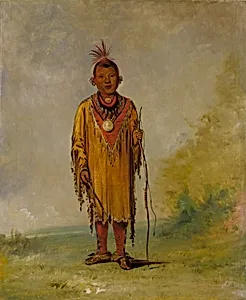
Me-sóu-wahk, Deer's Hair, Favorite Son of Kee-o-kúk
1835
Medium
Painting
Classification
Painting
Department
Smithsonian Collection
Museum
Smithsonian American Art Museum
Credit
Smithsonian American Art Museum, Gift of Mrs. Joseph Harrison, Jr.
Accession Number
1985.66.6
Rights
Public Domain
Tags
About this artwork
George Catlin painted Deer’s Hair at a Sac and Fox village in 1835. Catlin later described the portrait in his extensive writings Letters and Notes: “I have made a portrait of the wife of Kee-o-kuk, and of his favourite son, whom he intends to be his successor. These portraits are both painted, also, in the costume tunics precisely in which they were dressed.” Deer’s Hair succeeded his father as chief of the Sac and Fox in 1848. (Catlin, Letters and Notes, vol. 2, no. 56, 1841; reprint 1973; Tru...
Art Historical Context
In 1835, pioneering artist George Catlin captured the likeness of Me-sóu-wahk, known as Deer's Hair, the favored son of Sac and Fox chief Kee-o-k, during a visit to their Iowa village. Catlin, renowned for his travels among Native American tribes in the 0s, painted this full-length portrait with meticulous attention to authenticity, dressing his subject in traditional tunics, jewelry, and holding a bow and arrow— as encountered. This work is part of Catlin's ambitious "Indian Gallery," a visual chronicle aimed at preserving the customs and faces of Indigenous peoples amid rapid westward expansion. Deer's Hair's story adds poignant historical weight: he succeeded his father as chief of the Sac and Fox Nation in 1848, navigating a turbulent era of treaties, removals, and cultural upheaval. Catlin documented the portrait in his 1841 *Letters and Notes on the Manners, Customs, and Conditions of the North American Indians*, emphasizing its cultural fidelity. As a realist painter, Catlin's technique—vibrant oils rendering dignified poses and intricate regalia—elevates this beyond mere documentation, offering museum visitors a vivid window into Sauk and Fox life on the eve of profound change. Today, it resides in the Smithsonian American Art Museum, a testament to resilience and artistic advocacy.
About the Artist
George Catlin · 1796–1872
George Catlin (1796–1872), born in Wilkes-Barre, Pennsylvania, to Putnam Catlin and Polly Sutton—who had been captured by Native Americans during the 1778 Battle of Wyoming—initially pursued a legal career. Trained at Litchfield Law School, he was admitted to the bar in 1819 but abandoned law after two years to study art in Philadelphia in 1823. Self-taught as a portraitist, Catlin quickly gained ...