
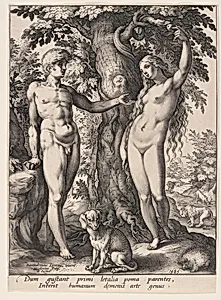
The Fall of Man
Medium
Engraving on laid paper
Dimensions
Sheet (trimmed): 21.1 × 15.5 cm (8 5/16 × 6 1/8 in.)
Classification
engraving
Department
Prints and Drawings
Museum
Art Institute of Chicago
Accession Number
267835
Rights
Public Domain
Art Historical Context
Behold *The Fall of Man*, a masterful 1585 engraving by Hendrick Goltzius, the preeminent Dutch printmaker of his era. This intimate work on laid paper (21.1 × 15.5 cm) captures the biblical moment from Genesis when Adam and Eve succumb to temptation, surrounded by sinuous serpents and lush foliage. Goltzius, a Haarlem-based artist influenced by Italian Mannerism, elevates the scene with dynamic figures that twist and strain, embodying the Northern Renaissance's blend of elegance and drama. As an engraving, the piece showcases Goltzius's revolutionary technique: bold, swelling lines etched into a copper plate create a painterly illusion of volume, light, and texture—effects rare in prints at the time. Laid paper, with its subtle chain lines, was prized for high-quality impressions, making this a prized collector's item in the Prints and Drawings department at the Art Institute of Chicago. This artwork reflects late 16th-century fascination with human frailty and divine judgment, circulated widely via prints to inspire moral reflection across Europe. Goltzius's virtuosity here foreshadowed the Dutch Golden Age, inviting viewers to ponder temptation's enduring allure.
About the Artist
Hendrick Goltzius · 1558–1617
Hendrick Goltzius (1558–1617) was the most celebrated engraver of the Northern Renaissance and a pivotal figure in Dutch Mannerism. Born near the German-Dutch border, Goltzius transformed printmaking into a virtuoso art form through his revolutionary 'swelling line' technique, where the burin was manipulated to create lines of varying thickness that produced unprecedented tonal effects and three-d...